
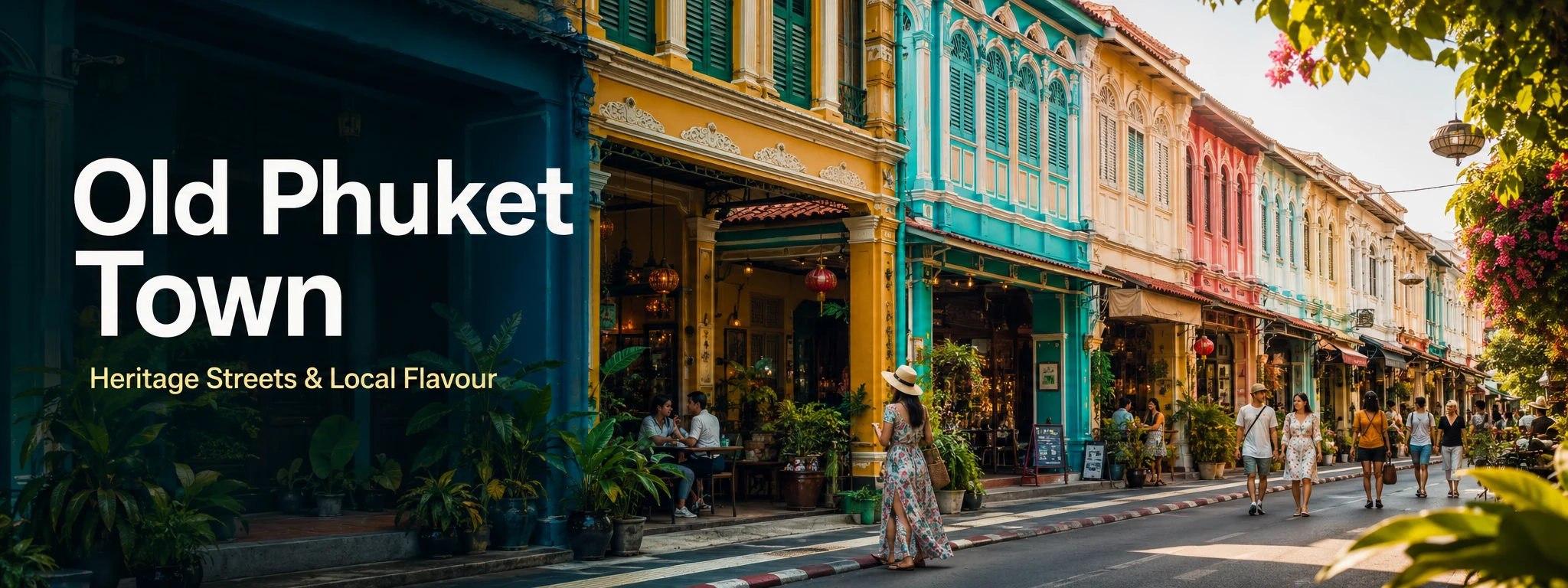

Old Phuket Town sits inland from the west-coast beaches and is the island's historic core — built on tin-mining wealth in the 19th and early 20th centuries, when Hokkien Chinese merchants and European trading families settled around what's now the Rassada, Thalang and Dibuk Road area. It's the one part of Phuket that looks nothing like a beach resort: no sea view, no sunset bars, just a compact grid of shophouses, shrines and coffee that rewards a few hours on foot.
Why it's worth the drive inland
Most first-time visitors base themselves on the west coast and treat Old Town as a half-day detour, which is about right — it's not a place to swim or sunbathe, it's a place to walk. What makes it different from the rest of Phuket is the architecture: rows of intact Sino-Portuguese shophouses, painted in mustard, teal and coral, with shuttered windows, air wells and covered five-foot walkways designed for shade during the mining boom. Nowhere else on the island has this much of it standing in one place.
Getting oriented
The old quarter is small enough to walk end to end in under half an hour. The main spine is Thalang Road, with Dibuk Road, Yaowarat Road, Krabi Road, Phang Nga Road and Rassada Road forming the rest of the grid worth wandering. Parking is tight and one-way streets are common, so many visitors park once near the Thai Hua Museum or the Phuket Provincial Hall area and cover the rest on foot.
Sunday Walking Street (Lard Yai)
On Sunday evenings, Thalang Road closes to traffic and becomes Lard Yai — food stalls, local crafts, live music and crowds fill the street from around 4pm until late. It's the single best time to see Old Town at its liveliest, though also its most crowded; arrive early evening if a hectic market isn't your thing, or lean into it for the atmosphere and street food.
Shrines, museums and quieter stops
Old Town has several Chinese shrines dating from the same mining-era community, including Put Jaw Shrine and Jui Tui Shrine — both central to Phuket's Vegetarian Festival processions each October. For history, the Thai Hua Museum (a restored 1930s Chinese-language school) covers the town's tin-mining and immigrant history in more depth than a walking tour alone can, and the small Phuket Philatelic Museum inside the old post office building is an easy, air-conditioned stop between streets.
Cafés, galleries and food
Old Town has become the island's best café scene almost by accident — restored shophouses now hold specialty coffee roasters, independent galleries and boutique guesthouses alongside the original noodle shops and dry-goods stores. It's also one of the few places in Phuket to try genuine Phuket-Peranakan (Baba) cooking, a Hokkien-Malay-Thai fusion distinct from mainland Thai food, in shopfront restaurants that have run for generations.
Best time to visit
Morning is best for photographing the architecture without crowds and before the heat sets in; Sunday afternoon into evening is best for the Walking Street market. Many galleries and museums close on Mondays, so it's worth checking ahead if a specific stop matters to you.
Going deeper
This page is the orientation — for a set walking route through the old quarter's streets and landmarks, see our self-guided heritage walk. For more on the architecture itself, the murals dotted through the backstreets, and the Baba-Peranakan community that built the town, see our Sino-Portuguese architecture guide, Old Town street art and Baba-Peranakan culture pages.
Getting there
Old Town is inland, roughly 30–40 minutes by road from the main west-coast beaches (Patong, Karon, Kata), and closer — around 15–20 minutes — from Chalong or Rawai in the south. Metered taxis, Grab and hotel transfers all run there easily; a scooter is another option if you're comfortable with Phuket traffic, though parking inside the old grid itself is limited.